
Report cards, sometimes called progress reports, provide written records of student performance on curriculum outcomes over a period of time. The School Act states that one of the roles of teachers is to “regularly evaluate students and periodically report the results of the evaluation to the students, the students’ parents and the board” (2000 cS-3 s18(e)). The Guide to Education (2013) states that “The assessment of student progress in relation to outcomes outlined in the programs of study is important…” and “…required for reporting student progress clearly to students and parents.” These two documents provide the legal basis for reporting student performance to both students and parents.
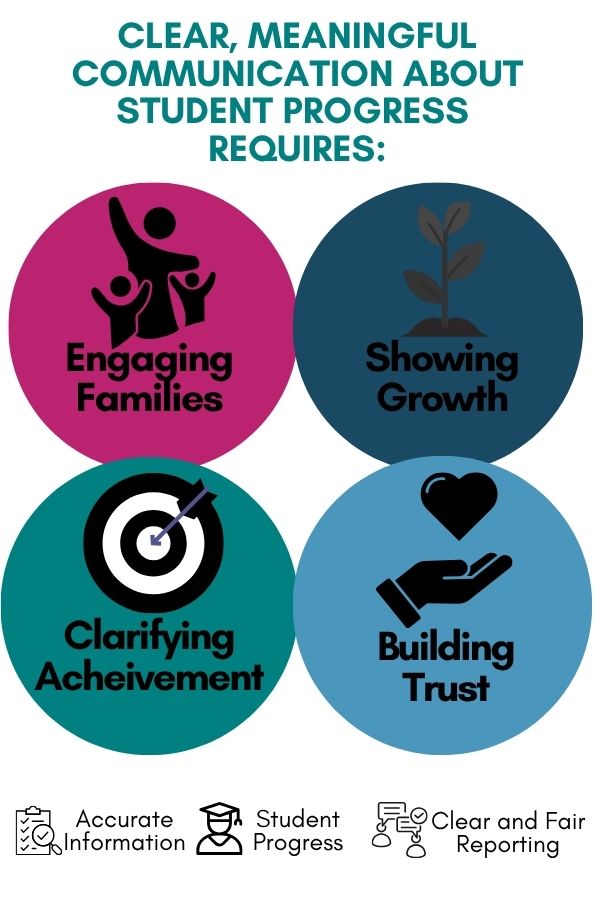
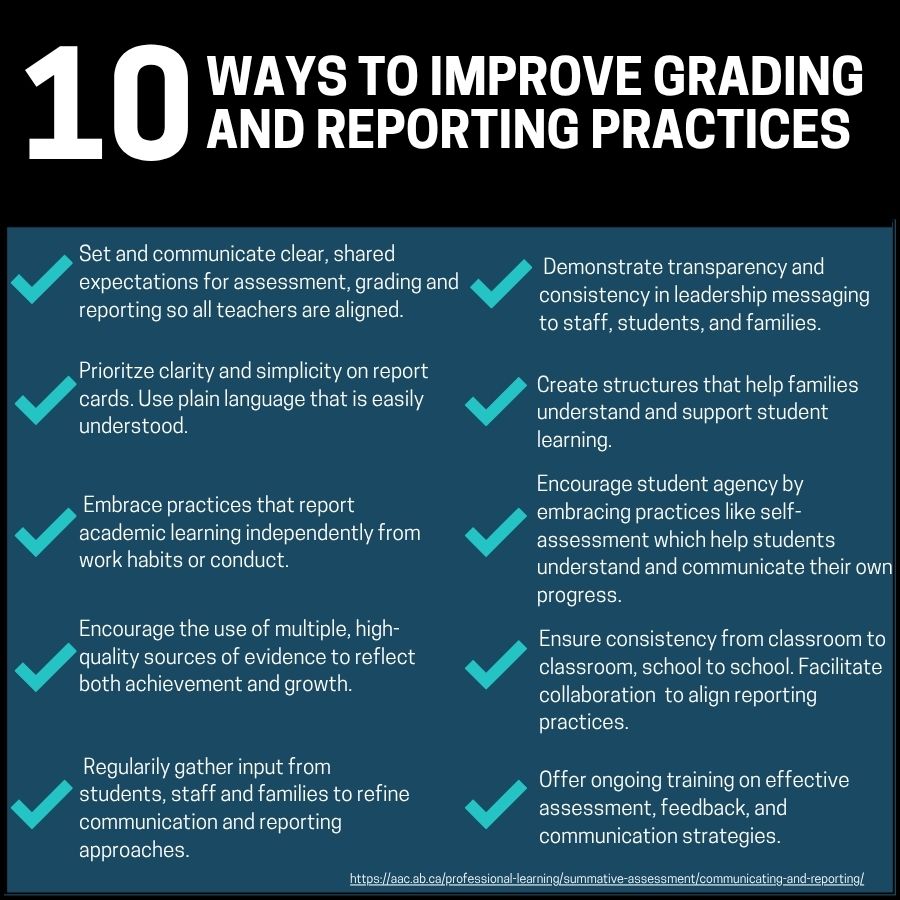
An effective report card is a document that can be easily understood by those for whom it is intended – parents and students. The report card should provide straightforward information about what a student knows and can demonstrate relative to the graded curriculum and what the student needs to do next. Educators have a responsibility to ensure that the judgements reported are an accurate and current reflection of student learning. Elements not related to the curriculum or not reflective of the student’s typical performance must be factored out. The report card should acknowledge actions that need to be taken by partners in learning – student, parents, and teachers.
The following definitions are consistent with those used by Alberta Education and endorsed by the Alberta Assessment Consortium.
achievement: a student’s demonstration of knowledge, skills and attitudes relative to grade level learner outcomes
assessment: process of collecting information on student achievement and performance that includes a variety of assessment tasks designed to monitor and improve student learning
assessment for learning: assessment experiences that result in an ongoing exchange of information between students and teachers about student progress toward clearly specified learner outcomes (also called diagnostic and formative assessment; refers to information not used for grading purposes)
assessment of learning: assessment experiences designed to collect information about learning to make judgements about student performance and achievement at the end of a period of instruction to be shared with those outside classrooms
(also called summative assessment; refers to performance data compiled as a grade)
evaluation: making decisions about the quality, value or worth of a response for the purpose of providing descriptive feedback (formative) and marks (summative)
learner outcomes: what we expect students to learn; the provincially mandated knowledge, skills and attitudes we expect students to demonstrate as a result of schooling
mark: a letter, number or comment as a statement of student performance
performance: how well a student demonstrates grade level learner outcomes
performance assessment: a meaningful, real-life task that enables students to demonstrate what they know and can do in situations like those they will encounter outside the classroom as well as in situations that simulate how people do their work
NOTE: The term ‘progress report’ is sometimes used interchangeably with report card.
In this section, educators share their journey in designing and implementing a new report card. It highlights key considerations, challenges, and collaborative processes involved in developing a meaningful and effective reporting system.
Videos and Discussion Guide Topics
- Selecting the Outcomes to be Included in Outcomes-Based Reporting
- Implementing a New Reporting System
- Making Decisions about Student Performance Categories
- Deriving Input from Parents, Students and Educators
Please follow this link
In this section, educators argue that assessment should be based solely on evidence of student learning aligned with curriculum outcomes, excluding factors such as behaviour or lateness that can distort results. They emphasize the need for multiple sources of evidence and the use of professional judgment to ensure valid, reliable, and meaningful evaluations of student performance.
Video and Discussion Guide Topics:
- Supporting Collaboration among Teachers
- Assessing Student Performance in Relation to Curriculum Outcomes
- Gathering Evidence on the Full Range of Curriculum Outcomes
- Gathering and Recording Evidence of Student Learning
- Working Together to Determine What Acceptable Work Looks Like
Please follow this link
In this section, educators share that communication about student learning extends beyond report cards and should include ongoing, meaningful dialogue through various methods. They emphasize building partnerships with families, ensuring transparency with no surprises, and using multiple forms of communication to support understanding of student progress and next steps.
Video and Discussion Guide Topics
- Helping Parents Understand the Relationship between Assessment for Learning and Assessment of Learning
- Helping Parents Understand the Language Used to Communicate Learning
- Ensuring that Parents Receive Ongoing Information
- Timing of Formal Communication
Please follow this link
Effective reporting helps parents understand what their children know, can do, and need to learn next. These videos and discussion guides support school teams in reflecting on assessment, reporting, and communication practices that are clear, fair, and focused on student learning.
Video and Discussion Guide Topics
- Helping parents understand performance standards
- Using exemplars to clarify expectations
- Writing meaningful and curriculum-based comments
- Providing teachers with illustrative examples
- Keeping academic achievement separate from behaviour, effort, and work habits
- Collecting consistent evidence about student behaviour
- Gathering stakeholder input for progress report redesign
- Communicating behaviour and effort through meaningful conversations
Together, these resources are designed to support practical reflection and strengthen communication with students and families.
Please follow this link
Helping Students Reach their Potential
As educators, our goal is to ensure that all students have the opportunity to reach their potential. This goal permeates our work as we plan, teach, coach, assess, and report.
The follow video speakers emphasize how assessment and reporting practices can strengthen student learning through clarity, consistency, and relationships. Key ideas include the importance of articulating curriculum across grade levels, building strong communication between teachers, students, and parents, and ensuring feedback is meaningful and growth oriented. Together, these practices support student understanding of where they are in their learning and what they need to do next.
As You Watch, Consider
- How effectively do your current practices ensure learning is clearly connected and articulated from one grade to the next?
- In what ways do your communication practices help students and parents understand learning progress beyond grades or marks?
- How consistently do students experience feedback that highlights strengths, provides context, and identifies clear next steps?
- How do your current assessment and reporting practices build student confidence and engagement in learning?
- Where might you strengthen shared responsibility for student learning across teachers, students, and families?
AAC Members Only Content
Note: This content area is available to AAC Members Only. Please login or learn more about Membership.
AAC Members Only Content
Note: This content area is available to AAC Members Only. Please login or learn more about Membership.
AAC Members Only Content
Note: This content area is available to AAC Members Only. Please login or learn more about Membership.
The Alberta Assessment Consortium (AAC) would like to acknowledge the contribution of the following individuals for sharing information about communicating and reporting student learning in their school/jurisdiction.
Jill Alexander Teacher, Foothills School Division
Lois Gluck Supervisor Curricular Services, St. Albert Public
Linda Inglis Former Principal, G.H. Luck School
Janice Ottewell Teacher, Foothills School Division
Dorothy Paszkowski Teacher, Foothills School Division
Bryan Szumlas Director Instructional Services, Calgary Catholic
Colin Woelfle Consultant, Edmonton Public Schools
AAC would also like to acknowledge the contribution Ken O’Connor has made in heightening awareness of the important principles of communicating about student learning.