
Summative assessment provides a clear picture of what students have learned and supports sound professional judgment in determining performance.
This section supports an understanding in:
An Accurate Picture of Student Performance
Arriving at a sound judgement of student performance based on accurate and adequate evidence.
Combining Evidence in a Meaningful Way
Combining evidence from a variety of sources in a meaningful way to accurately represent what the student knows, understands and can do.
Communicating Student Learning
Sharing the story of student learning with parents and others who need to know, in ways that are accurate, fair, and supportive of growth.

Supporting Effective Grading and Reporting Systems
Many jurisdictions have recently updated—or are in the process of updating—their reporting systems. Whether developing a new system or refining an existing one, numerous factors must be considered, including the needs of diverse audiences.
Given the complexity of grading and reporting systems, AAC has developed an extensive collection of professional learning resources to support the many changes this work entails. Whether a school authority is moving toward outcome-based grading and reporting, implementing a new digital grade book, or analyzing and revising assessment policies, these resources are designed to support these significant shifts.
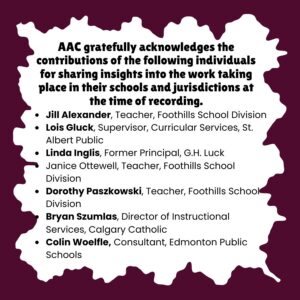
This video series provides a practical showcase of summative assessment in action, moving beyond theory to demonstrate how educators navigate the complexities of final evaluations. By observing a variety of classroom strategies, we explore whether summative evidence aligns with daily student performance and how to identify when further evidence is needed to bridge the gap. These videos offer a roadmap for synthesizing diverse data sources into a meaningful whole and provide clear models for communicating those findings to students and stakeholders with transparency and purpose.
The resources below bring together newly developed materials and earlier work (updated to ensure it remains relevant and meaningful). This collection includes over 50 videos from AAC member jurisdictions!
Please note that, due to the website redesign, some materials may appear in a different order or section than on the previous website.
An Accurate Picture of Student Performance
Combining Evidence in a Meaningful Way
Communicating Student Learning
Judging Student Performance in Relation to Curriculum Outcomes
Teachers must ensure that judgements of student performance are grounded in evidence of learning aligned to curricular outcomes. While factors such as behaviour, effort, and work habits are important, they should be reported separately and not influence the evaluation of achievement. Clear separation helps maintain accuracy, fairness, and consistency in how student learning is communicated.
The following videos and discussion questions ask school teams to reflect on:
- Prioritizing depth over breadth in the curriculum
- Connecting learning to purpose and relevance
- Separating achievement from behaviour in grading
- Rethinking grading practices and definitions of success
AAC Members Only Content
Note: This content area is available to AAC Members Only. Please login or learn more about Membership.
AAC Members Only Content
Note: This content area is available to AAC Members Only. Please login or learn more about Membership.
Differentiation: Even Within Summative Assessment
To truly honour student achievement, summative assessment must move beyond a one-size-fits-all approach. It should provide a fair, accurate reflection of what each student knows and can do. By differentiating at the summative level, we ensure we are measuring learning itself, not a student’s ability to succeed within a single format or constraint.
The following videos and discussion questions ask teams to reflect on:
- Differentiating assessments to accurately reflect learning
- Removing format barriers to demonstrate understanding
- Offering flexible ways to show mastery
- Separating learning goals from assessment methods
- Redefining fairness as readiness, not sameness
AAC Members Only Content
Note: This content area is available to AAC Members Only. Please login or learn more about Membership.
AAC Members Only Content
Note: This content area is available to AAC Members Only. Please login or learn more about Membership.
AAC Members Only Content
Note: This content area is available to AAC Members Only. Please login or learn more about Membership.
Rethinking Commonly Held Beliefs
Many traditional grading practices are rooted in the belief that penalties and consequences will motivate students to improve. However, these approaches can sometimes distort the true purpose of assessment, which is to accurately reflect learning. By re-examining these assumptions, educators can shift toward practices that prioritize mastery, growth, and meaningful accountability.
The following videos and discussion questions ask school teams to reflect on:
- Prioritizing learning over compliance in grading
- Using retakes and revisions to support mastery
- Separating academic achievement from behaviour
- Ensuring grades accurately reflect understanding
- Rethinking zeros, averages, and late penalties
AAC Members Only Content
Note: This content area is available to AAC Members Only. Please login or learn more about Membership.
AAC Members Only Content
Note: This content area is available to AAC Members Only. Please login or learn more about Membership.
AAC Members Only Content
Note: This content area is available to AAC Members Only. Please login or learn more about Membership.
AAC Members Only Content
Note: This content area is available to AAC Members Only. Please login or learn more about Membership.
AAC Members Only Content
Note: This content area is available to AAC Members Only. Please login or learn more about Membership.