
What Does Inclusive Assessment Mean?
Inclusive Assessment is the professional commitment to seeing and measuring learning in a way that honors student identity and belonging. It is the belief that how we evaluate students profoundly shapes who feels they have a place in our classrooms. When assessments honor multiple ways of showing understanding, they open doors for all learners.
Meaningful inclusion is about improving the presence, participation, and achievement of every learner, rather than merely grouping students (Ainscow, 2020). This means recognizing diversity as an expected and enriching feature of any learning environment (Florian, 2019; Slee, 2019). It is this diversity that invites us to design environments where all students are recognized as capable, valued, and connected.
Why Does It Matter?
Inclusive assessment matters because it provides meaningful information about learning that helps teachers design, adjust, and respond in ways that move all students forward—without lowering expectations.
Effective assessment helps both teachers and students stay focused on the learning journey. Three key questions can guide planning, instruction, and reflection. At any point in the learning process, students should be able to answer these questions about their own learning. (Chappuis, 2015; Wiliam, 2011):
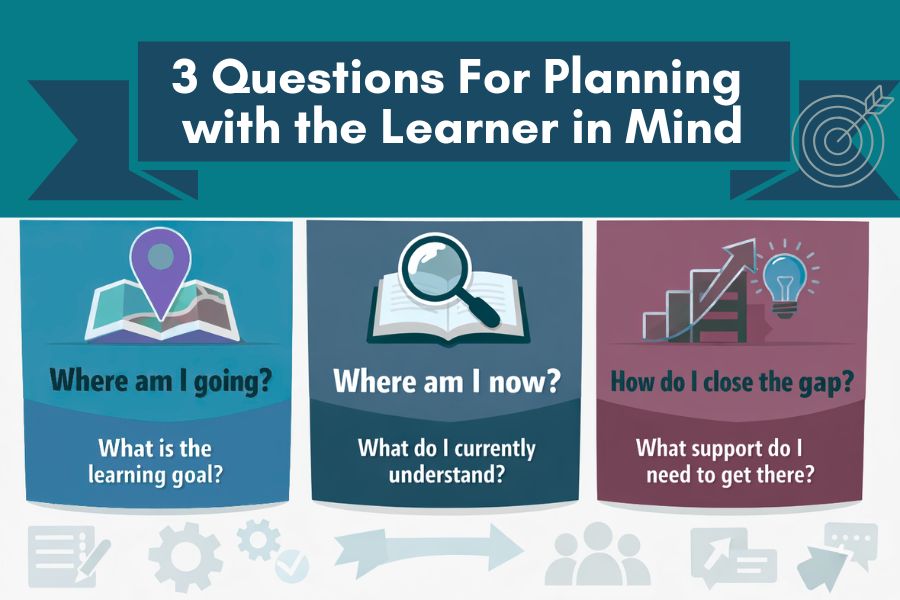
Inclusive assessment helps answer these questions for every learner. It ensures that goals are clear, evidence is meaningful, and supports are designed intentionally.
By attending to learner variability and using assessment evidence intentionally, teachers can create conditions where students experience success, develop confidence, and maintain a sense of belonging as they work toward shared learning goals.
In practice, inclusive assessment brings together proactive design and responsive support:
- Universal Design for Learning (UDL): Anticipating learner variability and planning for access from the start.
- Differentiation: Flexibly responding to learners’ needs as instruction and assessment unfold.
When assessment is designed proactively and used responsively, students experience greater agency, confidence, and a sense of belonging as learners.
For practical support for teachers, check out our resources in the ‘Learn More’ menu on the right.
References
Ainscow, M. (2020). Inclusion and equity in education: Making sense of global challenges. PROSPECTS, 49(3–4), 123–134. https://doi.org/10.1007/s11125-020-09506-w
Brookhart, S. M. (2017). How to use grading to improve learning. ASCD.
CAST. (2024). Universal Design for Learning guidelines version 3.0: The goal of UDL: Learner agency. Retrieved from https://udlguidelines.cast.org/more/udl-goal/
Chappuis, J. 2015. Seven strategies of assessment for learning, 2e. Upper Saddle River, NJ: Pearson Education.
Chardin, M., & Novak, K. R. (2021). Equity by design: Delivering on the power and promise of UDL. Corwin Press.
Florian, L. (2019). On the necessary co-existence of special and inclusive education. International Journal of Inclusive Education, 23(7–8), 691–704. https://doi.org/10.1080/13603116.2019.1622801
Griful‑Freixenet, J., Struyven, K., Vantieghem, W., & Gheyssens, E. (2020). Exploring the interrelationship between Universal Design for Learning (UDL) and Differentiated Instruction (DI): A systematic review. Educational Research Review, 29, 100306. https://doi.org/10.1016/j.edurev.2019.100306
Griful‑Freixenet, J., Struyven, K., & Vantieghem, W. (2021). Exploring pre‑service teachers’ beliefs and practices about two inclusive frameworks: Universal Design for Learning and differentiated instruction. Teaching and Teacher Education, 107, Article 103503. https://doi.org/10.1016/j.tate.2021.103503
Lindner, K.-T., & Schwab, S. (2020). Differentiation and individualisation in inclusive education: A systematic review and narrative synthesis. International Journal of Inclusive Education. Advance online publication. https://doi.org/10.1080/13603116.2020.1813450
Meyer, A., Rose, D. H., & Gordon, D. (2014). Universal Design for Learning: Theory and practice. CAST Professional Publishing.
Moore, S. (2016, October 28). Inclusion is Not Assimilation [Video]. YouTube. https://www.youtube.com/watch?v=AGptAXtvT0M
Slee, R. (2019). Belonging in an age of exclusion. International Journal of Inclusive Education, 23(9), 909–922. https://doi.org/10.1080/13603116.2019.1602366
Stiggins, R. J., & Chappuis, J. (2017). An introduction to student-involved assessment FOR learning (7th ed.). Pearson.
Thibodeau, T. (2025, September 5). The science and research behind the UDL framework. Novak Education. https://www.novakeducation.com/blog/the-science-and-research-behind-the-udl-framework
Tomlinson, C. A. (2014). The differentiated classroom: Responding to the needs of all learners (2nd ed.). Association for Supervision and Curriculum Development.
Wiliam, D. (2011). Embedded Formative Assessment. Bloomington, IN: Solution Tree Press.