
How do I combine evidence of learning in a meaningful way?
Elevating Assessment Through Professional Judgement
AAC Members Only Content
Note: This content area is available to AAC Members Only. Please login or learn more about Membership.
AAC Members Only Content
Note: This content area is available to AAC Members Only. Please login or learn more about Membership.
AAC Members Only Content
Note: This content area is available to AAC Members Only. Please login or learn more about Membership.
Amount of Evidence Required to Arrive at a Meaningful Representation of Performance
A meaningful representation of performance is defined by the quality, not the quantity, of assessments. Having a myriad of marks in a gradebook is less important than ensuring evidence reflects high-priority outcomes and enduring understandings. For instance, basing a Language Arts grade primarily on spelling quizzes—or a Mathematics grade on timed tests—fails to capture the true pedagogical intent of the curriculum.
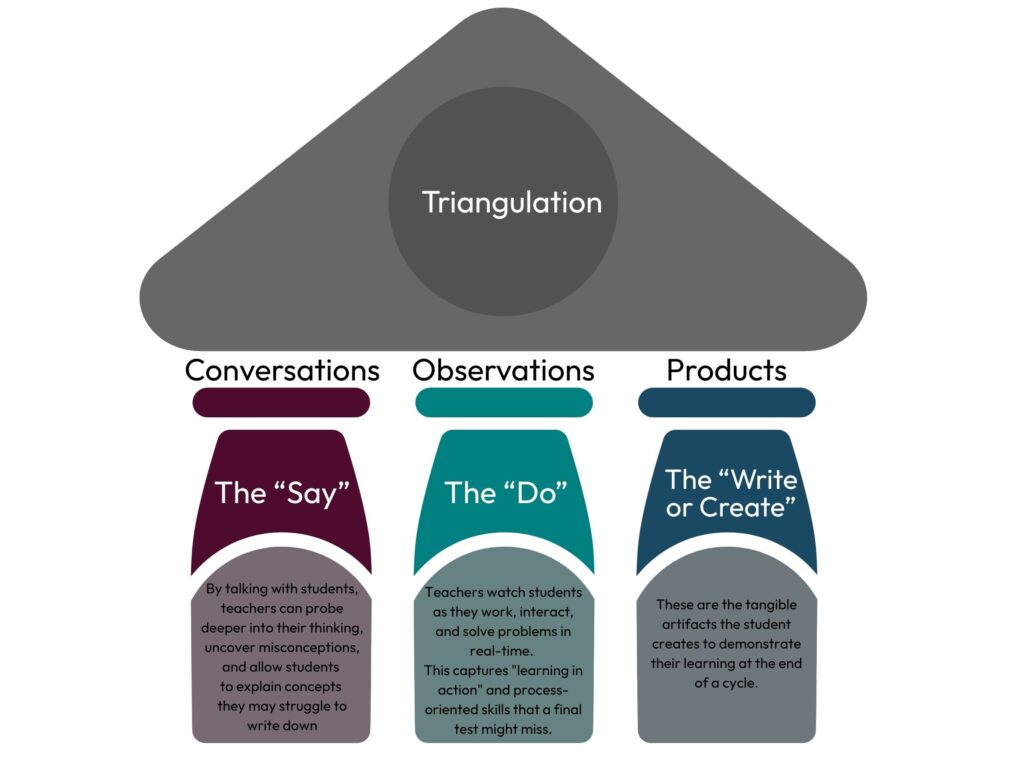
Instead, we arrive at an accurate assessment of achievement by triangulating evidence from observations, conversations, and products. By focusing on consistent patterns of learning over time rather than isolated events, teachers use professional judgement and collaboration to ensure reporting is fair, clear, and representative of what a student truly knows and can do.
The following videos invite school teams to reflect on:
- The balance between observations, conversations, and products in daily practice.
- How to define a “reasonable amount of evidence” without over-testing.
- The role of professional judgement in interpreting inconsistent patterns of learning.
- Strategies for making report card comments concise, focused, and family-friendly.
- Ways school leadership can support collaborative moderation and assessment consistency.
AAC Members Only Content
Note: This content area is available to AAC Members Only. Please login or learn more about Membership.
AAC Members Only Content
Note: This content area is available to AAC Members Only. Please login or learn more about Membership.
AAC Members Only Content
Note: This content area is available to AAC Members Only. Please login or learn more about Membership.
Using Teacher Observation, Anecdotal Comments, and Checklists as Part of the Body of Evidence
Teacher observations, anecdotal comments, and checklists are essential for gathering evidence of student learning. The intended outcome should guide how evidence is collected, with some outcomes best assessed through observation or conversation.
Assessment should include a range of approaches so all students can demonstrate their learning. Using observations, conversations, and products together, and gathering evidence over time, provides a more complete picture of student understanding.
Professional judgement is key in interpreting this evidence to ensure it reflects true learning. Relying only on pencil-and-paper tasks can limit what is seen, while varied approaches better capture deeper understanding.
The following videos and questions invite teams to reflect on:
- how effectively multiple sources of evidence, such as observations, conversations, and products, are used to create a complete picture of student learning
- how well assessment practices provide all students with opportunities to demonstrate their learning in different ways
- how formative assessment supports student reflection, ownership, and next steps
- how professional judgement is used to interpret and weigh evidence
- how reliance on a single form of assessment, such as pencil-and-paper tasks, may limit the ability to capture deeper understanding
AAC Members Only Content
Note: This content area is available to AAC Members Only. Please login or learn more about Membership.
AAC Members Only Content
Note: This content area is available to AAC Members Only. Please login or learn more about Membership.
AAC Members Only Content
Note: This content area is available to AAC Members Only. Please login or learn more about Membership.
Looking Beyond the Use of the Mean
Accurate and fair assessment requires professional judgement that reflects a student’s current level of learning. Relying on an arithmetic mean can misrepresent achievement, particularly when early attempts are averaged with later, more developed understanding. Shifting toward using the mode and emphasizing the most recent, consistent evidence allows grades to more accurately reflect what students know and can do.
This shift reflects a broader change in thinking about fairness, growth, and the purpose of assessment.
The following video invites school teams to reflect on:
- How grading practices account for improvement and the most recent evidence of learning
- The limitations of averaging in representing student achievement
- The role of professional judgement in determining final grades
- The connection between grading practices and beliefs about fairness and ethics
- How assessment practices can better support student growth and motivation
AAC Members Only Content
Note: This content area is available to AAC Members Only. Please login or learn more about Membership.